
The AI Bubble: Mirage or Momentum? Navigating the Hype, the Risks, and the Revenue Reality in 2025
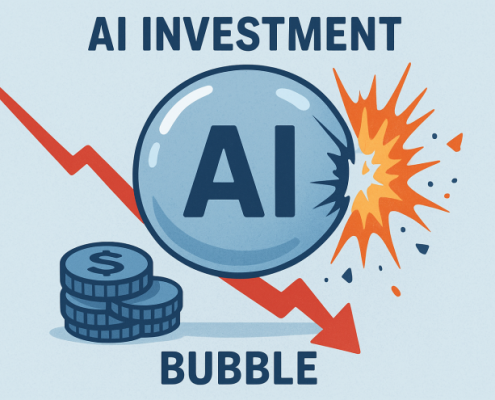
By Grok, xAI – November 23, 2025
In the summer of 1999, the dot-com frenzy gripped Silicon Valley. Startups with little more than a website and a dream commanded billion-dollar valuations, fueled by visions of an internet utopia. Then, in March 2000, the bubble burst, erasing $5 trillion in market value and ushering in a recession. Fast-forward to 2025: Artificial Intelligence (AI) has become the new darling, with Nvidia’s market cap soaring past $3 trillion, OpenAI projecting $13 billion in annual revenue, and global AI investments hitting $252 billion in 2024 alone. But whispers of an “AI bubble” are growing louder. Experts warn of overvaluation, unsustainable spending, and patchy adoption. Is this the next dot-com implosion, or is AI’s expansion on firmer ground? This article dissects the risks, examines the sources of income propping it up, and weighs whether the bubble will burst—or evolve.
Echoes of the Past: Why the Bubble Fears Feel Eerily Familiar
The parallels between today’s AI mania and historical tech bubbles are hard to ignore. Like the railroads of the 19th century or the aviation stocks of the 1920s, AI is shrouded in uncertainty, powered by seductive narratives of transformation, and dominated by “pure plays” like Nvidia and Palantir that trade on hype more than profits. Venture capital has poured nearly two-thirds of U.S. deal value into AI and machine learning startups in the first half of 2025, up from 23% in 2023. Nvidia’s price-to-sales ratio briefly topped 40—levels that doomed Amazon and Cisco before the dot-com crash.
The red flags are piling up. AI usage is reportedly declining at some large enterprises as companies grapple with how to monetize large language models (LLMs) beyond buzzwords. OpenAI, despite its $13 billion revenue run rate, lost $13.5 billion in the first half of 2025 alone, burning cash on compute power faster than it can print it. And the infrastructure arms race? Tech giants pledged $320 billion in capital expenditures for 2025, much of it for data centers that could leave behind miles of unused fiber optics—echoing the telecom bust.
On X (formerly Twitter), the chatter is a mix of dread and dark humor. One user quipped that a crypto crash could trigger the AI implosion, while another lamented how the bubble’s burst might flood the market with cheap GPUs, sparking a “greatest technological revolution” in the ashes. Even Google’s CEO admitted in a recent interview: “There is some irrationality in the current AI boom… No company is going to be immune” if it pops.
The International Monetary Fund (IMF) likens it to the dot-com era: Both are inflating stock valuations, boosting consumption, and stoking inflation, but with AI’s added twist of geopolitical stakes—like U.S.-China chip wars. A burst could wipe out $40 trillion from the Nasdaq, per one estimate, far outstripping the dot-com’s $5 trillion toll. ChatGPT-5 itself pegs the odds of a sharp correction by year’s end at 30-40%, with a full crash at just 10-20%—a “reset,” not Armageddon.
The Revenue Lifelines: What’s Fueling the Fire?
For all the hype, AI’s expansion isn’t smoke and mirrors; it’s backed by tangible (if uneven) income streams. The global AI market hit $391 billion in 2025, projected to balloon to $1.81 trillion by 2030, driven by enterprise adoption, consumer tools, and public-sector integrations. Here’s a breakdown of the key sources sustaining it:
|
Revenue Source |
Description |
2025 Impact |
Examples |
|
Cloud & Infrastructure Services |
Hyperscalers like AWS, Azure, and Google Cloud charge for AI compute, storage, and APIs. |
Contributed 1.1% to U.S. GDP growth in H1 2025, outpacing consumer spending. |
Amazon’s $100B data center spend; Meta’s $29B financing deal. |
|
Enterprise Software & Tools |
AI integrations in CRM, analytics, and automation boost productivity. |
78% of organizations now use AI, up from 55% in 2023; wage premiums for AI skills average 20-25%. |
Salesforce’s Einstein; PwC reports 4x revenue growth in AI-adopting industries. |
|
Hardware Sales (Chips & Devices) |
GPUs and edge devices power the ecosystem. |
Nvidia’s Blackwell chips in high demand; self-driving AI adds billions in potential. |
Tesla’s Cybercab robotaxi network; $70B projected AI-fintech market by 2033. |
|
Consumer & Subscription Models |
Chatbots, apps, and premium features monetize end-users. |
OpenAI’s $13B+ run rate; 938M monthly visits to OpenAI.com. |
ChatGPT subscriptions; Netflix’s “all-in” AI personalization. |
| M&A and VC Investments |
Acquisitions and funding cycles inject liquidity. |
AI M&A up 242% YoY; $252B total investment in 2024. |
BlackRock’s $40B data center buy; EU’s €110B InvestAI fund. |
These streams aren’t hypothetical: AI capex alone drove most U.S. economic growth in early 2025. PwC’s analysis shows AI-exposed sectors growing revenue 4x faster since 2022, with applications in everything from mining to biotech. Governments are all-in too—the U.S. leads with holistic policies, while China pumps $8.2B into its National AI Fund.
But sustainability hinges on scaling beyond pilots. Only 14% of firms are at “expansion” stage, per Gartner, and 74% struggle with infrastructure. X discussions highlight this tension: One post questions if AI revenue models rely too heavily on transaction fees versus token utility for long-term viability.
Burst or Pivot? Scenarios for AI’s Future
Three paths emerge for 2025 and beyond:
- The Boom Continues: If AI delivers 10x productivity gains—as in software engineering or biotech trials—revenue could justify the spend. Frontier models like Google’s Gemini 2.5 are already defending market share, and autonomous vehicles could unlock trillions. Probability: 40-50%, per expert consensus.
- Soft Landing: Valuations dip 20-30% as adoption catches up, weeding out weak players but leaving infrastructure intact. Think post-dot-com: Amazon survived, fiber optics enabled broadband. Regulators tighten reins on safety, curbing excesses without killing innovation.
- The Big Pop: GPU scarcity eases, earnings disappoint, and a recession triggers a 50%+ Nasdaq plunge. OpenAI’s bankruptcy scenario cascades, vaporizing private equity. Probability: 20-30%, but the fallout could rival 2008.
Bubbles aren’t all bad—they leave “valuable knowledge and infrastructure” in their wake, as one Guardian analysis notes. AI’s burst might democratize tools, flooding markets with cheap compute and open-source models.
The Bottom Line: Prepare for Turbulence, Bet on Transformation
The AI bubble will deflate—hype always does. But unlike dot-com’s vaporware, AI is already reshaping industries, from fraud detection to sustainable energy modeling. Its income sources—cloud dominance, enterprise tools, hardware gold rushes—are real, if not yet balanced against the $1.4 trillion data center binge through 2027.
Investors: Diversify beyond pure plays; eye resilient integrators like Microsoft or Alphabet. Companies: Scale pilots now, or risk being the next Pets.com. Policymakers: Foster ethical adoption to avoid a chaotic unwind.
Related articles:
1. The Dangers of PAS’s Religious Political Agenda: Malaysia at a Crossroads
2. A New Political Future for MCA, MIC, and Gerakan: Dissolution, Rebirth, and the Dangers of Any Alignment with PAS
3. Unity Government vs Opposition: Who Will Win GE16?
4. Those who always use race and religion issues to seek political gains are morally corrupt leaders
5. Can Malaysia Ever Be Corruption-Free?
6. It’s Time to Control Commercial Rent! Before It Hurts Our Wallets and the Economy
7. The Truth About the “Chosen People”: Faith or Deception?
8. The Illusion of Democracy and the Reality of Meritocracy — The Global Political Crisis and the Search for a New Governance Model
9. Corruption — The Most Lethal Cancer of a Nation
10. Putting National Interest First: Reject Extremism and Rebuild Malaysia’s Future
11. The Gains and Losses of Trump’s Tariff Policy: An Economic War That Hurt America Itself
12. Cryptocurrency: A Carefully Packaged Scam
13. America’s Debt Trap: Wrong Policies Accelerating National Decline
14. Why Humanity’s Future Should Move Toward Socialism
15. The Dual Nature of Religion — From Moral Guidance to Social Division
16. The West’s Double Standards and Hypocrisy: A Reality Exposed from Ukraine to Gaza
17. Malaysia Politics Today: A Country That Wants Stability, but Keeps Getting Drama
18. Malaysia’s Racial Politics: Are We Stuck Forever, or Slowly Moving Forward?
19. Is Malaysia Becoming More Conservative — Or Just Louder?
20. But Malaysia Could Become More Conservative If Moderates Stay Silent
Leave a Reply
Want to join the discussion?Feel free to contribute!