
The Future of OpenClaw and Self-Hosted LLMs: Will Local AI Agents Take Over Offices and Homes?
What Is OpenClaw?
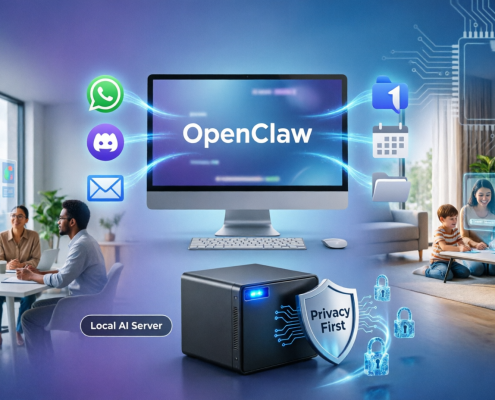
OpenClaw is an open-source, autonomous AI agent designed to run locally on your own computer, acting as a personal digital assistant that can manage tasks, interact with applications, and read/write files directly
. Launched in November 2025 (with a major public surge in early 2026), it connects to the messaging platforms you already use—WhatsApp, Telegram, Slack, Discord, Signal, iMessage, and more—to automate emails, scan calendars, browse the web, and execute complex workflows without constant human supervision.
Unlike cloud-based chatbots, OpenClaw operates on a local-first architecture: conversations, memory, and skills are stored as plain Markdown and YAML files on your disk, giving users full ownership and auditability of their AI’s “brain”
. The core Gateway is MIT-licensed, fully readable, and forkable—making it one of the most transparent AI agent frameworks available today
Why OpenClaw Matters for the Self-Hosted AI Movement
Privacy by Design
Modular “Skills” Ecosystem
OpenClaw uses a portable skill format (SKILL.md files with YAML frontmatter) that lets developers and power users extend functionality. Community members have already built skills for GitHub issue triage, expense tracking, meeting summarization, and even autonomous negotiation
. Skills can be shared via ClawHub (a community registry) or loaded directly from URLs.
True Autonomy with Guardrails
OpenClaw runs as a background daemon with a configurable “heartbeat” scheduler. On each cycle, it reviews a checklist (HEARTBEAT.md), decides whether action is needed, and either messages you or proceeds autonomously
. Crucially, tool policies and approval gates let users define boundaries: “Allow email reads, but require approval before sending” or “Permit file searches, but block deletions.”
Multi-Channel, Multi-Agent Flexibility
The Gateway acts as a single control plane routing messages across 20+ platforms while isolating sessions per workspace or user
. This means your “work OpenClaw” can operate on Slack with corporate data policies, while your “personal OpenClaw” handles WhatsApp messages—all on the same machine, with no cross-contamination.
Will OpenClaw and Self-Hosted LLMs Get Popular in the Next Few Years?
| Factor | Impact |
| Hardware Accessibility | Apple Silicon, NVIDIA RTX GPUs, and new NPUs in consumer PCs now make running 7B–70B parameter models locally feasible for non-experts |
| Tooling Maturity | Projects like Ollama, LM Studio, and OpenClaw itself have reduced setup from “hours of config” to “download and run.” |
| Regulatory Pressure | GDPR, HIPAA, and corporate data policies increasingly favor on-premises AI processing |
| Cost Predictability | No per-token fees. After hardware investment, inference is effectively free—a major advantage for heavy users. |
| Community Momentum | OpenClaw gained over 10,000 GitHub stars in under two weeks, signaling strong developer interest |
Barriers and Risks
| Challenge | Reality Check |
| Security Immaturity | OpenClaw is still evolving. Security researchers warn it behaves like “an over-eager intern with no real understanding of privacy”
. Infostealers have already targeted OpenClaw configurations to hijack agent identities |
| Permission Complexity | Granting an AI agent file access, shell execution, and browser control creates a large attack surface. Misconfiguration can lead to data exfiltration or unintended actions |
| Regulatory Caution | The Dutch data protection authority has warned organizations against deploying experimental agents like OpenClaw on systems handling sensitive data |
| Performance Trade-offs | Local models, even quantized, may lag behind cloud counterparts in complex reasoning or up-to-date knowledge without careful RAG setup |
Use Cases: Where OpenClaw Shines Today
In the Office
Secure Knowledge Assistant: Query internal documentation, HR policies, or codebases without sending data to external APIs
.
Automated Triage: Route support tickets, tag GitHub issues, or summarize meeting notes—all within your network perimeter.
Compliance-Aware Workflows: Configure approval gates for sensitive actions (e.g., “Require manager sign-off before emailing clients”).
In the Home
Personal Productivity Hub: Manage calendars, draft emails, or research topics via WhatsApp—without sharing personal data with third parties.
Smart Home Orchestrator: Chain actions like “If I leave home, lock doors, adjust thermostat, and notify family”—all processed locally.
Family Learning Companion: A tutoring bot filtered by parents, running entirely offline for children’s education.
The Road Ahead: 2026–2028 Predictions
Hybrid Deployments Will Dominate: Most users won’t run everything locally. Expect “local-first, cloud-fallback” patterns: sensitive tasks stay on-device; complex queries optionally route to cloud models with explicit consent.
Security Tooling Will Mature: Projects like OpenClaw will integrate better secret management, sandboxed execution environments, and audit logging. Third-party security scanners for agent configurations may emerge.
Enterprise “AI Appliances”: Companies will offer pre-hardened OpenClaw deployments—turnkey servers with vetted skills, role-based access, and compliance reporting—for SMBs lacking in-house AI expertise.
Regulatory Frameworks Will Catch Up: Expect new guidelines for “autonomous agent liability,” data provenance tracking, and user consent models for local AI systems.
User Experience Will Simplify: The current CLI/Git-centric workflow will evolve toward graphical installers, one-click skill stores, and mobile companion apps—lowering the barrier for non-technical users.
Final Thoughts: Empowerment Requires Responsibility
OpenClaw embodies a powerful vision: AI that serves you, not a platform. By putting control, data, and extensibility in users’ hands, it enables unprecedented personalization and privacy.
But with great power comes great responsibility. Running an autonomous agent with file system and network access demands careful configuration, ongoing vigilance, and a willingness to learn. As Malwarebytes aptly notes, treating OpenClaw as a “hardened productivity tool” today is premature—it’s more like a brilliant but inexperienced intern who needs clear boundaries
www.malwarebytes.com
.
For offices and homes willing to invest the time to configure, monitor, and secure their local AI agents, the next few years promise remarkable gains in productivity, privacy, and autonomy. For those seeking plug-and-play convenience, cloud AI will remain the pragmatic choice—for now.
The self-hosted AI revolution isn’t about replacing the cloud. It’s about expanding choice. And with projects like OpenClaw leading the charge, that choice is becoming real, accessible, and increasingly compelling.
Related articles:
1. Introduction: Suno AI – The Dawn of a New Musical Epoch
2. The Double-Edged Sword: AI’s Societal Impact and the Imperative for Governance
3. AI Music‘s New Frontier: A Look at Udio’s Innovative Approach
4. Vheer AI: Your Free, Unlimited Gateway to AI-Powered Visual Creativity
Leave a Reply
Want to join the discussion?Feel free to contribute!