
Beyond Static Commands: The Rise of the Self-Learning Hermes AI Agent
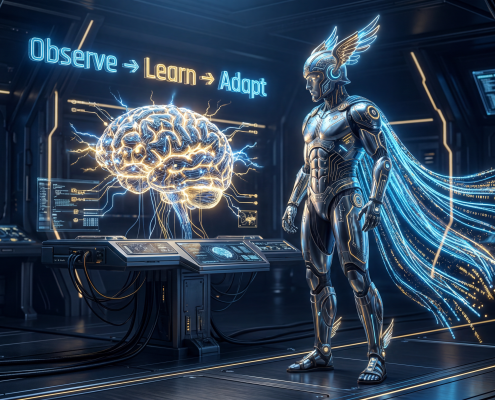
In the rapidly evolving landscape of artificial intelligence, we have grown accustomed to a specific transactional relationship with our tools: we ask, they answer. But what if your AI agent could learn from every interaction, adapt to your unspoken preferences, and even anticipate your needs before you articulate them? Enter the Self-Learning Hermes AI Agent—a new paradigm in autonomous intelligence named after the fleet-footed, communicative messenger of the gods.
Unlike traditional chatbots or rule-based assistants, a Hermes agent is designed to be a dynamic learner. It doesn’t just retrieve information; it interprets, remembers, and evolves.
What Makes a Hermes Agent “Self-Learning”?
The term “Hermes” in this context signifies more than speed. It represents the core functions of translation, mediation, and intelligent delivery. A self-learning Hermes agent is built on three foundational pillars:
-
Contextual Memory (Episodic Learning): Standard AI forgets everything after a session. A Hermes agent maintains a secure, evolving memory of past interactions. It learns that you prefer concise bullet points in the morning and detailed reports in the afternoon.
-
Reflexive Optimization (Reinforcement Learning from Feedback – RLHF): Every time you correct the agent (“No, I meant the sales report from Q3, not Q4”), it updates its internal weights. Over time, it stops making the same mistake twice.
-
Tool Synthesis (API Agnosticism): A true Hermes agent doesn’t just talk; it acts. It learns how to navigate your calendar, your CRM, and your code repository. When it discovers a more efficient way to fetch data (e.g., using a new API endpoint), it self-updates its own workflow.
How the Learning Loop Works
Imagine you deploy a Hermes agent to manage your customer support tickets. Day one, it is a blank slate—it knows the knowledge base but not your style. Day two, it begins to notice patterns.
The loop looks like this:
-
Observe: The agent resolves a ticket about a software bug.
-
Act: It tags the ticket “Engineering – Critical.”
-
Evaluate: You manually change the tag to “Engineering – Low Priority” because the bug only affects a legacy feature.
-
Learn: The agent logs the discrepancy between its action and your correction. It updates its decision tree.
-
Iterate: The next time a similar bug appears, the agent correctly tags it as “Low Priority.”
Within a week, the Hermes agent has effectively become a personalized extension of your team’s logic, reducing manual oversight by 80%.
The Technical Architecture (Simplified)
For developers looking to build such an agent, the architecture differs significantly from a standard RAG (Retrieval-Augmented Generation) model.
-
Vector Database with Temporal Weighting: Memories decay over time unless reinforced. The agent uses a vector store where older, unused memories are compressed, while frequently accessed preferences are boosted.
-
Dual-Process Reasoning: The agent operates with two modes. “System 1” (fast, heuristic-based) handles routine tasks. “System 2” (slow, deliberate) kicks in when the agent encounters a novel situation, reasoning step-by-step before committing the solution to memory.
-
Reflection Loops: Periodically (e.g., every night at 2 AM), the agent reviews its log of mistakes and successes, generating synthetic training data from real interactions to fine-tune its own smaller, local model.
Use Cases Where Hermes Shines
While generic LLMs are good for brainstorming, the self-learning Hermes agent excels in repetitive, variable environments.
-
Personal Finance: The agent learns your spending habits and begins flagging unusual transactions before they post, having learned from last month’s false positive.
-
DevOps Monitoring: It learns which log warnings are noise and which are precursors to a crash. Over time, it starts executing pre-written remediation scripts autonomously.
-
Legal Research: A Hermes agent learns a specific law firm’s argument style. It doesn’t just find cases; it learns which judges tend to favor specific precedents and adjusts its research accordingly.
The Challenge: Forgetting and Alignment
Self-learning is not without risk. The primary danger is overfitting to the user. If a manager has a bad day and gives harsh feedback, the agent might learn to be overly cautious or evasive.
Thus, a robust Hermes agent requires two critical features:
-
A “Revert” button: The ability to roll back learned behaviors to a previous checkpoint.
-
Constitutional Constraints: A hard-coded set of rules (e.g., “never delete data,” “never impersonate a human”) that the learning algorithm cannot override, no matter what it observes.
The Future is Conversational Evolution
We are moving away from the era of “Artificial Intelligence” as a static utility and toward “Adaptive Intelligence” as a partner. The self-learning Hermes AI agent represents the first true step toward software that grows with you.
It does not arrive perfect. It arrives curious. And through every conversation, every correction, and every successful task, it becomes faster, smarter, and more indispensable. The messenger, it turns out, is also the student.
Are you ready to teach your AI? Because very soon, you won’t have a choice—it will be learning from you anyway.
Related articles:
1. Introduction: Suno AI – The Dawn of a New Musical Epoch
2. The Double-Edged Sword: AI’s Societal Impact and the Imperative for Governance
3. AI Music‘s New Frontier: A Look at Udio’s Innovative Approach
4. Vheer AI: Your Free, Unlimited Gateway to AI-Powered Visual Creativity
5. The Future of OpenClaw and Self-Hosted LLMs: Will Local AI Agents Take Over Offices and Homes?
Leave a Reply
Want to join the discussion?Feel free to contribute!