
Titans of the OS Landscape: MS Windows vs. HarmonyOS in 2026
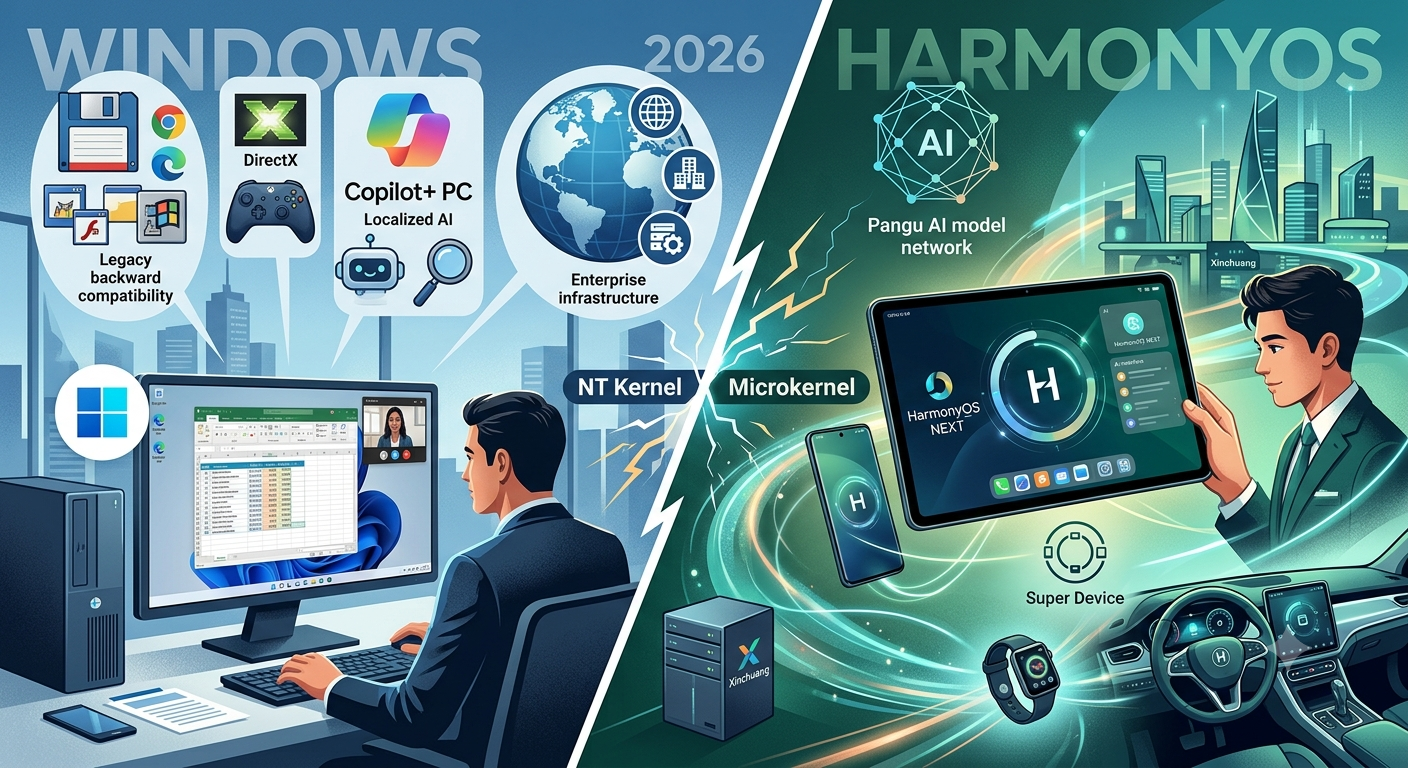
For decades, Microsoft Windows has been the undisputed king of the desktop and enterprise computing world. However, the rise of Huawei’s HarmonyOS (Hongmeng) has introduced a paradigm shift. Originally designed as an alternative for mobile and IoT devices, HarmonyOS has evolved into a comprehensive, distributed operating system that now challenges traditional PC ecosystems.
To understand how these two tech giants compare, we must look beyond simple feature lists and examine their underlying philosophies, ecosystems, and visions for the future of computing.
1. Architectural Philosophy: Monolithic Legacy vs. Distributed Microkernel
Microsoft Windows (The NT Kernel) Windows is built on the Windows NT kernel, a hybrid/monolithic architecture that has been refined over 30+ years. Its greatest strength is also its greatest burden: backward compatibility. Windows can run software from the 1990s alongside modern AI-accelerated applications. However, this requires a massive, complex codebase that can be resource-heavy and vulnerable to security exploits if not rigorously patched.
HarmonyOS (The Distributed Microkernel) HarmonyOS was built from the ground up with a microkernel architecture designed for a “distributed” world. Instead of requiring a different OS for a watch, a phone, a car, and a PC, HarmonyOS uses a single, scalable framework.
- Security & Efficiency: By keeping only the most essential services in the microkernel, HarmonyOS reduces attack surfaces and improves real-time performance.
- HarmonyOS NEXT: By 2025/2026, Huawei completed its transition to “HarmonyOS NEXT,” entirely shedding legacy Android (AOSP) libraries to become a purely independent, native ecosystem.
2. Feature Comparison & Ecosystem
A. Software Ecosystem and Compatibility
- Windows: Windows possesses an insurmountable global moat in legacy software, enterprise tools, and PC gaming (via DirectX). If a business relies on specialized CAD software, deep Excel macros, or decades-old ERP systems, Windows is non-negotiable.
- HarmonyOS: Huawei’s native app ecosystem has exploded in China, with major developers building dedicated HarmonyOS NEXT apps. However, globally, it lacks the native Win32/x86 software library. To bridge this on PCs, Huawei has relied on translation layers and cloud-based desktop solutions, though native HarmonyOS PC applications are rapidly growing in the Chinese domestic market.
B. Cross-Device Continuity
- Windows: Microsoft has improved cross-device features (like Phone Link and cross-clipboard syncing), but it relies heavily on third-party OEM hardware and cloud-based handoffs. The experience can sometimes feel fragmented depending on the device manufacturer.
- HarmonyOS: This is Huawei’s crown jewel. Through its “Super Device” architecture, HarmonyOS treats multiple devices as a single hardware pool. You can seamlessly drag and drop files between a Huawei phone and tablet, use a tablet as a secondary touch-screen for a HarmonyOS PC, or hand off a video call from a phone to a smart TV or an AITO smart car dashboard with zero latency and no third-party apps required.
C. AI Integration
- Windows: With the maturation of Copilot+ PCs, Windows has deeply integrated local AI (via NPUs) into the OS. Features like live translation, system-wide visual search (Recall), and localized generative AI are standard in 2026.
- HarmonyOS: Huawei integrates its Pangu AI models directly into the system level via its native AI assistant (Xiaoyi/Celia). Because HarmonyOS controls the hardware-software stack on its flagship devices, it offers highly contextual AI—such as summarizing cross-app data, intelligent smart-home routing, and predictive resource allocation—often with better privacy safeguards due to local processing.
3. The Big Question: Will HarmonyOS Replace MS Windows?
The short answer is: Globally, no. Regionally and sectorally, it already is.
To understand the future, we have to divide the market into three distinct battlegrounds:
1. The Global Consumer & Enterprise Market (Windows Wins)
In the global market (North America, Europe, and much of Asia), Windows is deeply entrenched. The switching costs for global enterprises are too high, and the global gaming community relies entirely on Windows and DirectX. Furthermore, Microsoft’s partnerships with OEMs (Dell, HP, Lenovo, Asus) ensure Windows is pre-installed on the vast majority of the world’s PCs. HarmonyOS is unlikely to replace Windows in the global consumer PC space in the foreseeable future.
2. The Chinese Government & Enterprise Sector (HarmonyOS is Replacing Windows)
In China, the “Xinchuang” (IT localization and innovation) initiative has mandated the removal of foreign hardware and software from government, military, and state-owned enterprise infrastructure.
- Huawei has developed HarmonyOS PC specifically for this market.
- By 2026, HarmonyOS is actively replacing Windows in Chinese government offices, educational institutions, and critical infrastructure. For these users, domestic security, self-reliance, and integration with local enterprise software make HarmonyOS the new default.
3. The Post-PC / IoT / Automotive Era (A Different Kind of Replacement)
Where HarmonyOS truly threatens Windows is not by beating it at the PC game, but by making the traditional PC less relevant.
- Smart Cockpits: HarmonyOS is the dominant OS in China’s booming EV market. The car is becoming the new “desktop.”
- Ambient Computing: As smart home hubs, AR glasses, and advanced tablets take over daily productivity tasks, the need for a traditional clamshell laptop running Windows diminishes. In the IoT and smart-device continuum, HarmonyOS has already surpassed Windows, which has largely failed to capture the mobile and IoT markets.
Conclusion: Coexistence and Divergence
As of 2026, MS Windows and HarmonyOS are not on a direct collision course for total global domination; rather, they are diverging into different realms of computing.
Microsoft Windows remains the undisputed heavyweight champion of traditional productivity, legacy enterprise workflows, and global PC gaming. Its ongoing AI evolution ensures it will remain a staple of the corporate world for decades.
HarmonyOS, on the other hand, represents the future of distributed, ambient computing. It has successfully replaced Windows in China’s state sectors and has beaten Windows entirely in the IoT, wearable, and automotive spaces.
HarmonyOS will not “kill” Windows globally. Instead, it is building a parallel universe—one where the smartphone, the smart car, and the smart home act as a single, unified computer, leaving the traditional Windows PC as just one of many optional screens in a much larger digital ecosystem.
Other related articles:
Leave a Reply
Want to join the discussion?Feel free to contribute!