
The Failure of Modern Democracy: When Popularity Overpowers Competence
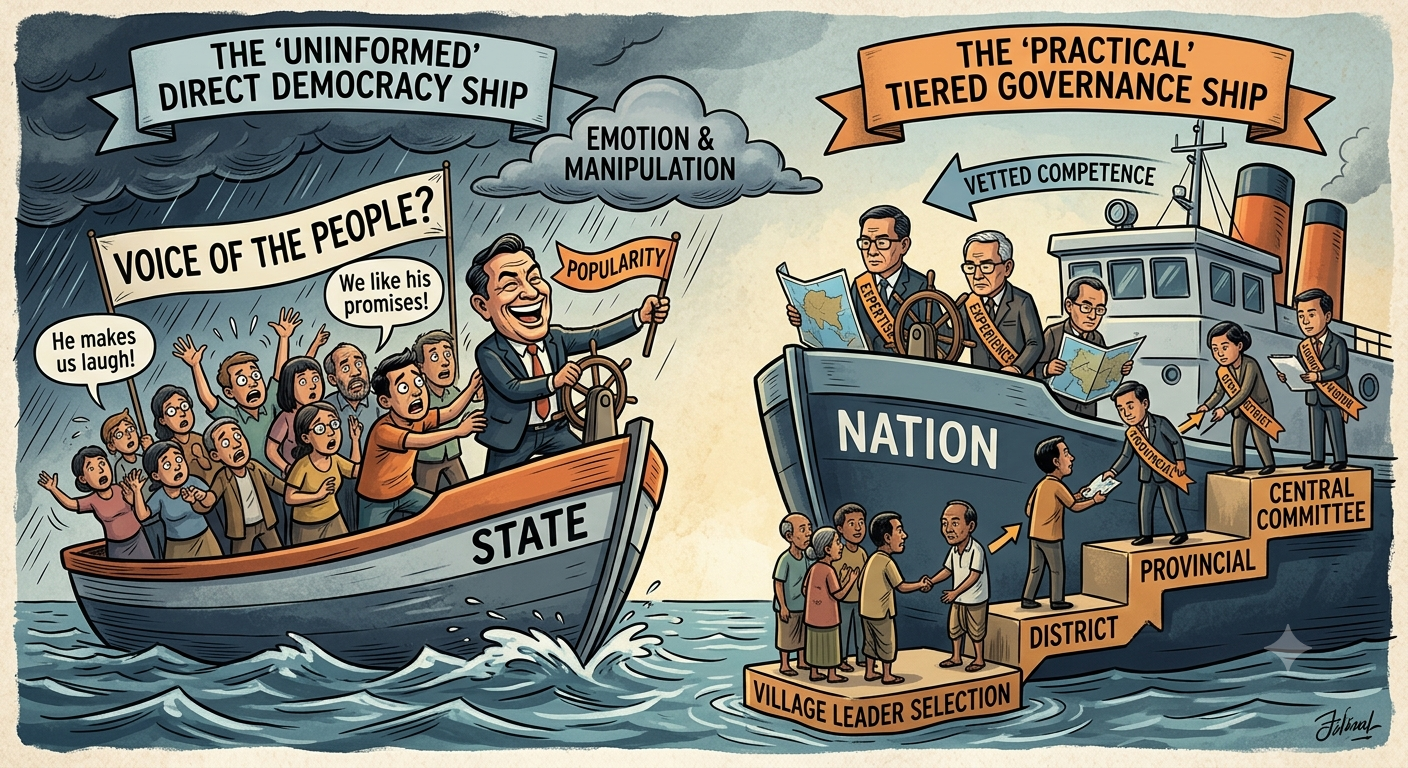
The concept of “one person, one vote” is often heralded as the ultimate moral benchmark of modern governance. It promises equality, participation, and a voice for the common citizen. However, history’s most incisive minds—from Plato to George Bernard Shaw—have long warned that this system contains an inherent, structural weakness: it assumes that democratic legitimacy is synonymous with wisdom, when in reality, it may only measure the success of persuasion.
The Tyranny of the Uninformed
The central critique of the “one person, one vote” model is that it treats all opinions as equal, regardless of the level of expertise, foresight, or civic engagement behind them. As Plato famously illustrated through his “Ship of State” analogy in The Republic, a ship captain should be chosen for their knowledge of navigation, not for their ability to win a popularity contest among the passengers.
In a modern democracy, we often demand that our leaders possess the equivalent of complex navigational skills—the ability to manage global economies, navigate international diplomacy, and oversee intricate public infrastructure. Yet, the system often incentivizes politicians to prioritize rhetoric over reality, catering to the immediate emotional desires of the electorate rather than the long-term necessities of a functioning state.
From “Corrupt Few” to “Incompetent Many”
George Bernard Shaw famously quipped that democracy merely “substitutes election by the incompetent many for appointment by the corrupt few.” This observation strikes at the heart of the failure of the modern political machine:
-
The Incentive Structure: When leaders are beholden to an electorate that may not be fully informed on complex policy issues, they are incentivized to engage in populism. The goal becomes winning the next cycle rather than securing the next generation.
-
The Burden of Complexity: Modern issues—such as artificial intelligence regulation, climate policy, and national debt—require a depth of study that the average citizen, preoccupied with their own livelihood, simply cannot dedicate. When votes are cast without sufficient knowledge of the stakes, the “will of the people” becomes a volatile variable.
-
The Erosion of Expertise: Because the system values the quantity of votes over the quality of governance, expertise is often treated as a liability rather than an asset. A candidate who explains hard truths often loses to one who offers comforting, yet unattainable, promises.
The Illusion of Equality
The democratic ideal is built on the premise that the aggregate of individual preferences will naturally gravitate toward the common good. However, this relies on the assumption of a well-informed, rational citizenry. When mass media, echo chambers, and emotional branding dominate the political landscape, the “one person, one vote” system can transform into a mechanism that empowers those who are best at manipulating public sentiment rather than those best suited to lead.
The irony of modern democracy is that by striving to avoid the tyranny of the elite, we may have inadvertently created a system where the pursuit of power necessitates the degradation of discourse.
Conclusion: A Crisis of Quality
To question the “one person, one vote” system is not necessarily to advocate for its abandonment, but to acknowledge its fundamental fragility. If we are to bridge the gap between the democratic ideal and the reality of effective governance, we must find ways to elevate the importance of expertise and long-term planning within the political process. Without a commitment to an informed, educated electorate that prizes competence over charisma, democracy risks becoming exactly what its greatest critics feared: a vessel steered by those who are most popular, rather than those who actually know how to sail.
Do you believe that institutionalizing “knowledge requirements” or shifting toward a technocratic model could solve these issues, or would that inevitably lead back to the “corrupt few” that democracy was designed to replace?
Related articles:
1. The Dangers of PAS’s Religious Political Agenda: Malaysia at a Crossroads
2. A New Political Future for MCA, MIC, and Gerakan: Dissolution, Rebirth, and the Dangers of Any Alignment with PAS
3. Unity Government vs Opposition: Who Will Win GE16?
4. Those who always use race and religion issues to seek political gains are morally corrupt leaders
5. Can Malaysia Ever Be Corruption-Free?
6. It’s Time to Control Commercial Rent! Before It Hurts Our Wallets and the Economy
7. The Truth About the “Chosen People”: Faith or Deception?
8. The Illusion of Democracy and the Reality of Meritocracy — The Global Political Crisis and the Search for a New Governance Model
9. Corruption — The Most Lethal Cancer of a Nation
10. Putting National Interest First: Reject Extremism and Rebuild Malaysia’s Future
11. The Gains and Losses of Trump’s Tariff Policy: An Economic War That Hurt America Itself
12. Cryptocurrency: A Carefully Packaged Scam
13. America’s Debt Trap: Wrong Policies Accelerating National Decline
14. Why Humanity’s Future Should Move Toward Socialism
15. The Dual Nature of Religion — From Moral Guidance to Social Division
16. The West’s Double Standards and Hypocrisy: A Reality Exposed from Ukraine to Gaza
17. Malaysia Politics Today: A Country That Wants Stability, but Keeps Getting Drama
18. Malaysia’s Racial Politics: Are We Stuck Forever, or Slowly Moving Forward?
19. Is Malaysia Becoming More Conservative — Or Just Louder?
20. But Malaysia Could Become More Conservative If Moderates Stay Silent
21. The 2026 Economic Outlook: Navigating a Terrain of Transition and Risk
22. Rwanda: From the Ashes of Tragedy to a Beacon of African Progress
Leave a Reply
Want to join the discussion?Feel free to contribute!