
DeepSeek-V4 and the Shifting Landscape of Global AI Leadership
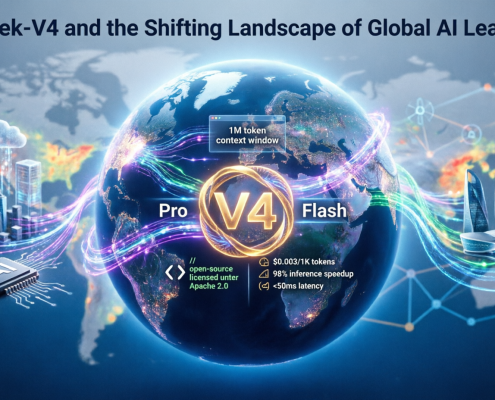
This is not merely another model launch. It represents a strategic inflection point with profound implications for the narrative of U.S. AI dominance.
| Feature | DeepSeek-V4-Pro | DeepSeek-V4-Flash |
| Total Parameters | 1.6 Trillion | 284 Billion |
| Active Parameters | 49 Billion (MoE) | 13 Billion (MoE) |
| Context Window | 1 Million tokens (standard) | 1 Million tokens (standard) |
| Max Output | 384K tokens | 384K tokens |
| Primary Focus | Frontier performance, complex rea | Speed, cost-efficiency, high-frequency tasks |
| Pricing (per 1M tokens) | Input: $1.00–$12.00 / Output: $24.00 | Input: $0.028–$1.00 / Output: $2.00 |
| License | Open-weight, permissive | Open-weight, permissive |
Both models feature a 1 million-token context window as a default standard, enabled by novel attention mechanisms including Token-wise Compression and DeepSeek Sparse Attention (DSA) . At this context length, V4-Pro requires only 27% of the inference FLOPs and 10% of the KV cache memory compared to its predecessor, DeepSeek-V3.2—a breakthrough in long-context efficiency.
2. Open-Weight Distribution as a Strategic Lever
By releasing model weights under permissive licenses on platforms like Hugging Face, DeepSeek enables global developers to self-host, fine-tune, and integrate V4 without dependency on proprietary APIs. This accelerates adoption in regions wary of U.S. tech dependency and empowers startups to build competitive applications without recurring API fees. The open-weight approach effectively commoditizes frontier capabilities that U.S. firms have sought to monetize through closed ecosystems.
3. Architectural Innovation Over Raw Scale
|DSML|) designed for robust agentic workflows. These innovations allow the model to maintain coherence across million-token contexts—a critical requirement for real-world applications like codebase analysis, legal document review, and multi-step planning.4. Hardware Agnosticism and Domestic Ecosystem Alignment
Reports indicate DeepSeek-V4 has been optimized to run efficiently on non-NVIDIA hardware, including Huawei’s Ascend AI accelerators. This reduces reliance on U.S.-controlled semiconductor supply chains and strengthens China’s domestic AI infrastructure. As one commentator noted: “The biggest progress may be achieving perfect operation on Huawei’s CANN architecture, not NVIDIA’s CUDA”
Implications for U.S. AI Strategy
U.S. labs can no longer assume that superior benchmark scores alone will sustain market leadership. Enterprises increasingly evaluate AI solutions based on total cost of ownership, integration flexibility, data sovereignty, and regulatory compliance—areas where open-weight, locally deployable models hold distinct advantages.
A bifurcated global AI ecosystem is emerging: a U.S.-led stack centered on proprietary models, cloud-native deployment, and stringent safety frameworks; and a parallel open-weight ecosystem gaining traction across Asia, the Middle East, and parts of Europe. DeepSeek-V4 strengthens the latter by providing a high-performance, openly accessible foundation.
U.S. restrictions on advanced GPU exports aimed to slow Chinese AI progress. Yet DeepSeek-V4 demonstrates that architectural innovation and software optimization can partially offset hardware constraints. This may prompt U.S. policymakers to reconsider whether export controls should extend to model weights, training methodologies, or open-source collaboration frameworks—a move fraught with diplomatic and innovation-tradeoff risks.
DeepSeek’s open-weight releases attract global researchers and developers, potentially drawing talent away from closed U.S. labs. Conversely, U.S. institutions retain advantages in foundational research, venture capital access, and enterprise trust. The competition is increasingly about who builds the most trusted, adaptable, and widely adopted AI infrastructure—not just the most powerful model.
Looking Ahead: A Multipolar AI Future
- Deployment scalability: Can the technology be reliably integrated into healthcare, manufacturing, finance, and public services?
- Standards influence: Who shapes evaluation protocols, safety guidelines, and international governance norms?
- Developer experience: Which platforms offer the most intuitive tooling, documentation, and community support?
- Cost-performance balance: Who delivers frontier capabilities at prices accessible to small businesses and emerging economies?
Conclusion
Related articles:
1. Introduction: Suno AI – The Dawn of a New Musical Epoch
2. The Double-Edged Sword: AI’s Societal Impact and the Imperative for Governance
3. AI Music‘s New Frontier: A Look at Udio’s Innovative Approach
4. Vheer AI: Your Free, Unlimited Gateway to AI-Powered Visual Creativity
5. The Future of OpenClaw and Self-Hosted LLMs: Will Local AI Agents Take Over Offices and Homes?
6. Beyond Static Commands: The Rise of the Self-Learning Hermes AI Agent
Leave a Reply
Want to join the discussion?Feel free to contribute!