
The ‘Me First’ Presidency: Analyzing Thomas L. Friedman’s Critiques of Donald Trump
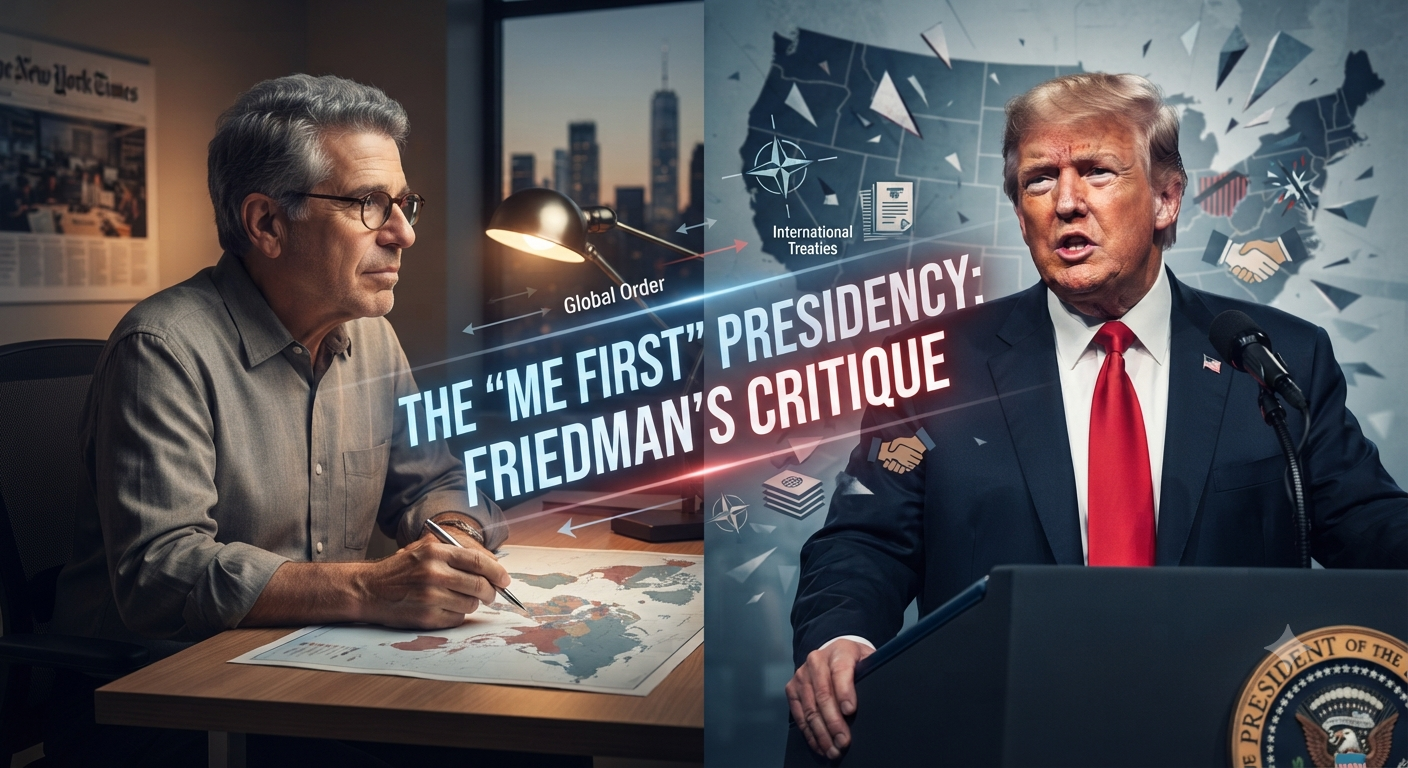
For decades, New York Times foreign affairs columnist Thomas L. Friedman has chronicled the shifts in global economics, international relations, and American politics. Among his frequent subjects, Donald Trump has drawn some of Friedman’s most severe and sustained rebukes. Across multiple election cycles and presidential terms, Friedman’s critiques have evolved from warnings about unconventional governance to deeper diagnoses of what he views as a fundamental threat to democratic norms and global stability.
1. From “America First” to “Me First” Politics
One of Friedman’s most prominent arguments is that Donald Trump’s political philosophy is a misnomer. Rather than advancing a coherent doctrine of “America First,” Friedman has argued that Trump’s agenda is driven entirely by personal ego, branding, and grievance—effectively operating as a “Me First” administration.
Friedman has frequently pointed to foreign policy maneuvers and personal correspondence as evidence that national interest is subordinate to personal validation. In his columns, he has asserted that Trump’s governance style reflects a deep-seated narcissism, where diplomatic relationships, international treaties, and alliances are weighed against how they reflect on Trump’s own legacy, media coverage, or desire for accolades like the Nobel Peace Prize.
2. The Erosion of Alliances and the Transatlantic Rift
As a staunch advocate of traditional American global leadership and multilateral institutions, Friedman has severely criticized Trump’s handling of long-standing alliances, particularly NATO and trade partnerships with Europe.
Friedman has argued that Trump treats geopolitical relationships as purely transactional real estate deals rather than bedrock security partnerships. By threatening to abandon mutual defense pacts or imposing erratic tariffs on democratic allies, Friedman contends that Trump has systematically dismantled the post-World War II global order—a framework that Friedman believes has historically guaranteed American prosperity and security.
3. Institutional Decay and White House Dysfunctions
Beyond foreign policy, Friedman has focused heavily on the domestic architecture of governance under Trump. He has frequently written about the degradation of institutional norms, the erosion of the civil service, and the absence of internal checks within the executive branch.
Friedman has expressed alarm over what he perceives as a lack of guardrails in the White House. In his critiques, he has often questioned whether advisers and cabinet officials adequately challenge presidential impulses, suggesting that an environment of sycophancy enables erratic decision-making that bypasses traditional national security protocols.
4. Unpredictability as a Destabilizing Force
While some political analysts view Trump’s erratic unpredictability as a useful negotiation tactic (often referred to in political science as the “madman theory”), Friedman views it as an acute danger.
Friedman has argued that steady, predictable American leadership is the anchor of the global economy and international security. When the U.S. president elevates unpredictability to a primary governing strategy, Friedman contends that it forces adversaries and allies alike into a state of anxious hedging, increases the risk of catastrophic miscalculation, and diminishes America’s soft power.
Summary
Thomas L. Friedman’s body of work on Donald Trump frames the former and returning president not merely as a disruptive political figure, but as a structural challenge to the foundations of American democracy and international order. Whether analyzing trade wars, diplomacy, or rhetorical posture, Friedman’s consistent thesis is that Trump’s brand of politics substitutes institutional wisdom and collective security with personalized grievance and short-term transactionalism.
Thomas Friedman: “The World Will Push Back” Against Trump | Amanpour and Company
This video provides additional context from Thomas L. Friedman directly discussing how global powers and international systems respond to the policies and shifting world order under the Trump administration.
Related articles:
1. The Dangers of PAS’s Religious Political Agenda: Malaysia at a Crossroads
2. A New Political Future for MCA, MIC, and Gerakan: Dissolution, Rebirth, and the Dangers of Any Alignment with PAS
3. Unity Government vs Opposition: Who Will Win GE16?
4. Those who always use race and religion issues to seek political gains are morally corrupt leaders
5. Can Malaysia Ever Be Corruption-Free?
6. It’s Time to Control Commercial Rent! Before It Hurts Our Wallets and the Economy
7. The Truth About the “Chosen People”: Faith or Deception?
8. The Illusion of Democracy and the Reality of Meritocracy — The Global Political Crisis and the Search for a New Governance Model
9. Corruption — The Most Lethal Cancer of a Nation
10. Putting National Interest First: Reject Extremism and Rebuild Malaysia’s Future
11. The Gains and Losses of Trump’s Tariff Policy: An Economic War That Hurt America Itself
12. Cryptocurrency: A Carefully Packaged Scam
13. America’s Debt Trap: Wrong Policies Accelerating National Decline
14. Why Humanity’s Future Should Move Toward Socialism
15. The Dual Nature of Religion — From Moral Guidance to Social Division
16. The West’s Double Standards and Hypocrisy: A Reality Exposed from Ukraine to Gaza
17. Malaysia Politics Today: A Country That Wants Stability, but Keeps Getting Drama
18. Malaysia’s Racial Politics: Are We Stuck Forever, or Slowly Moving Forward?
19. Is Malaysia Becoming More Conservative — Or Just Louder?
20. But Malaysia Could Become More Conservative If Moderates Stay Silent
21. The 2026 Economic Outlook: Navigating a Terrain of Transition and Risk
22. Rwanda: From the Ashes of Tragedy to a Beacon of African Progress
23. The Failure of Modern Democracy: When Popularity Overpowers Competence
24. The $13 Billion Mirage: How Michael Saylor’s Bitcoin Gamble Crossed the Line into Madness
25. A Classic Case of the “Tyranny of the Majority”
26. 选举问责制的严重侵蚀
Leave a Reply
Want to join the discussion?Feel free to contribute!