
Economist Jeffrey Sachs Delivers Blistering Critique of Donald Trump’s “Mickey Mouse Economics”
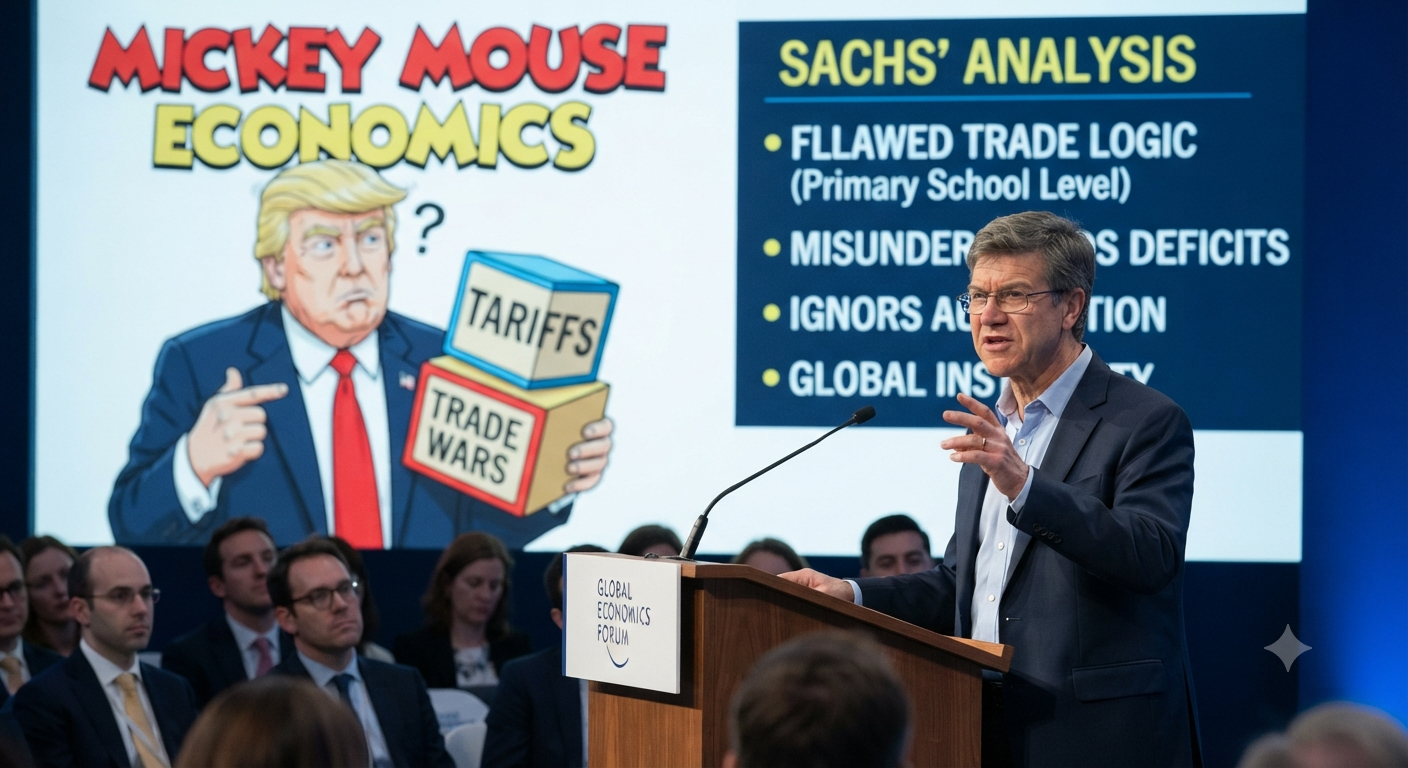
Renowned economist and Columbia University professor Jeffrey Sachs has launched a fierce critique of Donald Trump’s economic philosophy, characterizing his trade strategies as fundamentally flawed, “childish,” and dangerous for global stability. Sachs didn’t hold back, asserting that Trump’s grasp of international trade and macroeconomic fundamentals is so deficient that “he wouldn’t pass a basic econ class”.
The Core of the Critique: Flawed Trade Logics
At the heart of Sachs’ condemnation is Trump’s fixation on trade deficits, which the economist labels as a primary school-level misunderstanding of global commerce. Sachs targeted justifications made by the Trump administration regarding bilateral trade imbalances—such as penalizing smaller nations because they export more to the U.S. than they import—describing the rationale as entirely “delusional”.
“They made some absolutely stupid formula that you would not accept in a first-year, third-week economics class,” Sachs remarked regarding the administration’s approach to calculating country-specific tariffs.
Coining the term “Mickey Mouse economics,” Sachs joked that even cartoon characters possess a better grasp of financial realities than what is currently guiding U.S. trade policy. He argued that trade deficits are fundamentally a reflection of domestic spending and savings habits rather than foreign “cheating”.
Blaming Trade Instead of Automation
Sachs also criticized the political narrative used to appeal to industrial swing states. He pointed out that blaming foreign entities like China, Mexico, or smaller developing nations for manufacturing job losses masks the true structural evolution of the economy. According to Sachs, the decline of manufacturing jobs in America’s industrial heartland is driven predominantly by technological advancements and automation—such as robots on assembly lines—rather than overseas trade dynamics.
Global Repercussions and Geopolitical Approach
Beyond specific tariff policies, Sachs warned that the broader economic fallout has been catastrophic, estimating trillions of dollars in lost global wealth due to market uncertainty and protectionist friction. Connecting economic policy to wider foreign affairs, Sachs has frequently described the U.S. approach to global negotiations and geopolitical shifts as lacking maturity, reducing complex international frameworks to a reactive mindset.
Ultimately, Sachs frames Trump’s economic strategy not as a coherent fiscal policy, but as a political performance that trades long-term global well-being for short-term populist narratives.
Jeffrey Sachs criticizes Donald Trump trade policy
This video provides an in-depth look at Jeffrey Sachs’ scathing remarks regarding Donald Trump’s tariff threats and economic policies.
Related articles:
1. The Dangers of PAS’s Religious Political Agenda: Malaysia at a Crossroads
2. A New Political Future for MCA, MIC, and Gerakan: Dissolution, Rebirth, and the Dangers of Any Alignment with PAS
3. Unity Government vs Opposition: Who Will Win GE16?
4. Those who always use race and religion issues to seek political gains are morally corrupt leaders
5. Can Malaysia Ever Be Corruption-Free?
6. It’s Time to Control Commercial Rent! Before It Hurts Our Wallets and the Economy
7. The Truth About the “Chosen People”: Faith or Deception?
8. The Illusion of Democracy and the Reality of Meritocracy — The Global Political Crisis and the Search for a New Governance Model
9. Corruption — The Most Lethal Cancer of a Nation
10. Putting National Interest First: Reject Extremism and Rebuild Malaysia’s Future
11. The Gains and Losses of Trump’s Tariff Policy: An Economic War That Hurt America Itself
12. Cryptocurrency: A Carefully Packaged Scam
13. America’s Debt Trap: Wrong Policies Accelerating National Decline
14. Why Humanity’s Future Should Move Toward Socialism
15. The Dual Nature of Religion — From Moral Guidance to Social Division
16. The West’s Double Standards and Hypocrisy: A Reality Exposed from Ukraine to Gaza
17. Malaysia Politics Today: A Country That Wants Stability, but Keeps Getting Drama
18. Malaysia’s Racial Politics: Are We Stuck Forever, or Slowly Moving Forward?
19. Is Malaysia Becoming More Conservative — Or Just Louder?
20. But Malaysia Could Become More Conservative If Moderates Stay Silent
21. The 2026 Economic Outlook: Navigating a Terrain of Transition and Risk
22. Rwanda: From the Ashes of Tragedy to a Beacon of African Progress
23. The Failure of Modern Democracy: When Popularity Overpowers Competence
24. The $13 Billion Mirage: How Michael Saylor’s Bitcoin Gamble Crossed the Line into Madness
25. A Classic Case of the “Tyranny of the Majority”
26. 选举问责制的严重侵蚀
27. The ‘Me First’ Presidency: Analyzing Thomas L. Friedman’s Critiques of Donald Trump
Leave a Reply
Want to join the discussion?Feel free to contribute!